
Koulouri Thessalonikis - Street Food
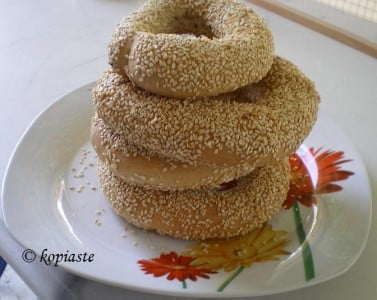
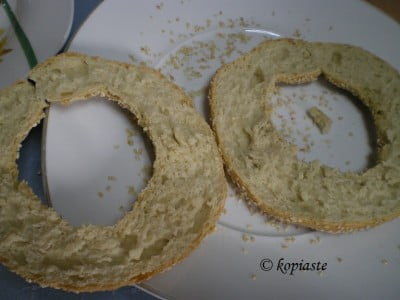
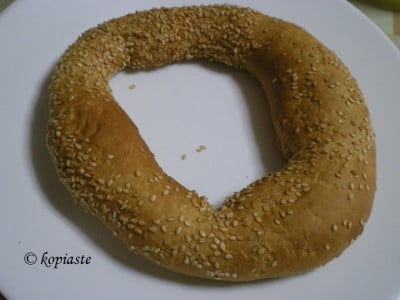
Koulouri Thessalonikis (also called Simitiko), is a street food, round shaped bread product with a hole in the middle, covered with sesame seeds, crunchy outside and soft inside.
It is one of our healthiest snacks as it is low in fat but very nutritional and most dietitians / nutritionists will tell you to eat one for breakfast or as a snack. In addition, it is very cheap, as it costs around 0,50 – 0,60 cents.
The street vendors also sell some of those triangle cheese (not to mention the name) with the smiling cow to accompany it.
It dates back to the early years of Christianity. This played an important role in their nutrition but it was widely made known during the Byzantine years when it first appeared in Constantinople and strange enough it became popular in Thessaloniki when the refugees brought it back in 1922.The word koulouri comes from the ancient Greek “κολλίκιον”, kollikion, which means a round bread made with coarsely ground wheat and this is mentioned in many Byzantine scripts.
The profession of bread making or koulouri making was exercised mainly by Greeks from Heperus who immigrated to Constantinople and it is said that their heads were funny shaped because of the weight they had to carry every day, as they had to carry baskets or wooden planks with koulouria on their heads. This was a highly respectable (and may be prosperous) profession at the time because the mothers would bless their sons and wish them all the luck to become vendors of koulouria in Constantinople.
These craftsmen would begin heating their ovens burning wood just after midnight and then they would prepare the yeast, make the dough and before the crack of dawn everything was ready.The wonderful smell of baked bread and sesame seeds was a temptation no one could resist.The street vendors with the load of baskets or planks with koulouria on their heads, would scatter towards all directions and by 10-11 a.m. they were sold out.
In Constantinople the vendors would advertise their product by shouting out loud to attract people “Koulouria Thessalonikis”. Many years later, the refugee-vendors coming from Asia Minor to Athens, would sell the same product calling it with the same name and selling it in the same way they used to do this profession for hundreds of years. This is how this popular snack has taken its name.
(Source: Adapted and translated by me from The Union of Bread makers of Thessaloniki)

Koulouri was and still is wonderful as a snack for any time of the day, especially for breakfast.

You can eat it as it is or cut in the middle with butter and honey or jam, or with any filling you might choose. My favourite (first picture above) is butter, halloumi, smoked turkey and citrus marmalade.
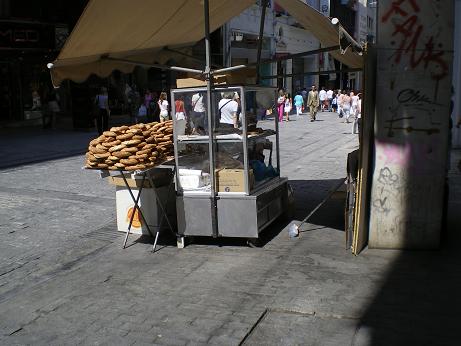
Nowadays koulouria are sold either in bakeries or by street vendors in the crowded streets with shops, nearly one at every corner selling thousands of them.
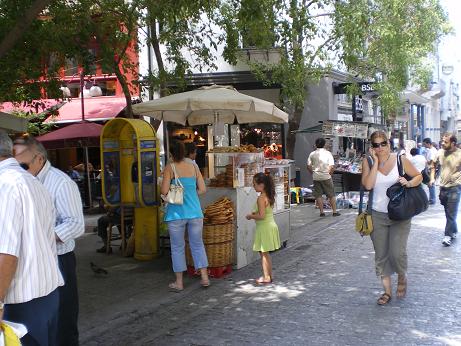
On Sundays you can find them outside churches, as people go to church without eating, so when the liturgy finishes it is a lovely treat until you get home for breakfast.
Koulouria Thessalonikis - Street Food
Preparation time: 1 hour
Baking time: 20 - 25 minutes
Makes: 10 - 12
Ingredients
- 500 grams of bread flour(reserve ½ cup)
- 1 sachet dried yeast (9grams)
- 1 cup of lukewarm* water
- ½ teaspoon of sugar
- ½ teaspoon of salt
- ¼ cup of olive oil
- 250 grams of sesame seeds
Tip: We can test the water by putting our little finger in the water. If we can stand the heat then the water is fine.
Directions
- In a large bowl add the flour, dry yeast, salt, sugar and olive oil and mix together until the oil is absorbed by the flour. (You can do this in the mixer but the procedure is so easy that it is easier to make it without a mixer). Start adding water, gradually and mix until the dough is not sticking on the bowl and on your hands. If it is add some more of the flour you have reserved until the dough is ready.
- Cover with a clean towel and leave it to rise until it doubles in volume (about half an hour depending on the temperature).
- When the dough has risen, knead it again for five minutes. Divide the dough into ten or 12 pieces about the size of an egg and dust your working surface with flour and shape into a cord about 30 centimeters long.
- Dip it quickly into lukewarm water and then transfer it into the sesame. Press both ends and stick them together shaping them into circles.
- Preheat oven to 200 degrees C and bake for about 20 minutes or until they have a golden colour outside.
- Serve them, preferably warm.
If they are too many for you to eat you can put them in zip lock bags before or after baking them and freeze them.
I am submitting this recipe to Susan, of Wild Yeast, who is hosting the event Yeastspotting.
You can find many Greek recipes in my cookbook "More Than A Greek Salad", and "Mint, Cinnamon & Blossom Water, Flavours of Cyprus, Kopiaste!" both available on all Amazon stores.
Other relevant recipes:
Kopiaste and Kali Orexi,

I'm so glad you blogged about these Ivy...and we get a bonus history lesson too! These are a favourite and as you say, no one can resist them!
Thanks Peter, I'm in the mood of writing a few traditional recipes now that I have some spare time.
Wow! Those look delicious! They kind of remind me of bagels (shape wise and because of the sesame seeds). I am going to have to try these! 🙂
Jenn,thanks. I never had bagels before so I can't say if they are similar but they are quite simple to make.
Hi Lore, after Jenn's comment I google searched bagel and they do look alike. I think their only difference is that the bagels are boiled before baking. I am tempted to make some bagels now (lol)
Ditto to Jenn. Your yummy pics make me feel that great bagle taste in my mouth right now! I will try your version Ivy because they do look scrumptious 🙂
Congrats on another great post, Ivy! I remember visiting Athens a few years back and buying some from a street vendor. It was very early in the morning when they were still warm... the we're so good, I still remember the sesame smell!
I would say that these are similar to a sesame bagel although bagels are somewhat more dense, with a texture that is slighty more chewy or elastic.
Oh Ivy, it's been too long since I've had one of these beauties! I've never tried making them myself, but I definitely think I need to give them a go!
Nikolas, thanks. They are really, I mean really good when they are warm.
Elly, thanks, it's so easy to make them.
wow! they are looking yummy! added u to my blog roll ivy! since u r new to my blog, u send in ur entries for the event (i accept it) bcoz am going to post the round up day after tomorrow only!
This looks awesome, I have never tried 🙂 after seeing your recipe its tempting me 😉
For the coconut chutney I have psoted, you can use dry coconut also. But fresh coconut will be more tasty.
Thanks srilekha. Shall try and do my best to send you one tomorrow as today I have another recipe to post which I mentioned in my yesterday's post.
Thank you Vani as well as telling about the coconut. The reason I asked is that fresh coconut is something we cannot get easily, perhaps only in big supermarkets 🙂
Hi Ivy,
First time I saw this bread along the streets of Athens, I admired the shape and smell but I didn't eat any because ... it's toooo big portion... LOL.
I'm worried I can't finish and I need to allocate some space in my stomach for other food later. I never seen such bread, well, ok accept Aunt Annie's Pretzels 😛 My Greek friend even teased me that I can even play hoop games with it if I buy a stack of them.
Next trip I'm in Greece, I'm going to buy some and use the bread to play hoops on him instead!
Thanks for the recipe! I will keep it in file for my next adventure! :-*
pixen
Pixen are you kidding? It seems that we eat too much in Greece because one is never enough 🙂