
Traditional Lagana flatbread
Lagana (in Greek λαγάνα, pronounced lah-GHAH-nah) is a traditional Greek flatbread, which is made with flour, yeast, salt, water and sesame seeds.
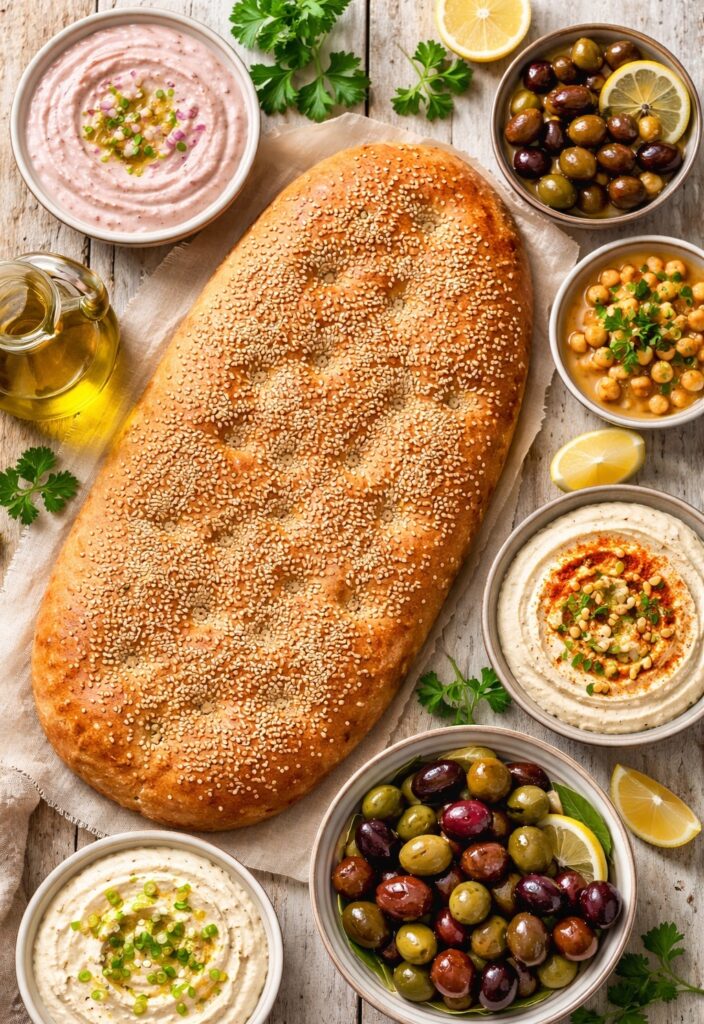
Originally it was an unleavened bread but eventually some yeast was added.
This bread sees the light of day once a year, on the first day of the Greek Orthodox Lent, known as Clean or Green or Shrove Monday.
The name comes from laganon, a thin broad cake, of meal and water. The Romans called it "lasanum", which is also the origin of the word lasagna, also known as tracta, from Ancient Greek τρακτὸς.
This traditional Greek bread is made dairy free as it is used for fasting and hence it is a great vegan flatbread.
If you are new to baking, I would absolutely recommend trying this recipe out. It is one of the easiest bread recipes and a great way to make friends with yeast.
The procedure is very straight forward with very basic ingredients. It's shaped like a rectangle with rounded corners, and is a fairly flat loaf.
Make the dough, let it rise, put it on your work space and stretch. Then the bread is baked and served.
The bread tastes great by itself or served with the other Lenten food such as taramosalata, olives, halvas, etc.
I really cannot understand why it is not made year around, as everybody is crazy about this bread.
Try it also by adding other ingredients in it. I've made it into an olive flatbread or with olives and sun-dried tomatoes.
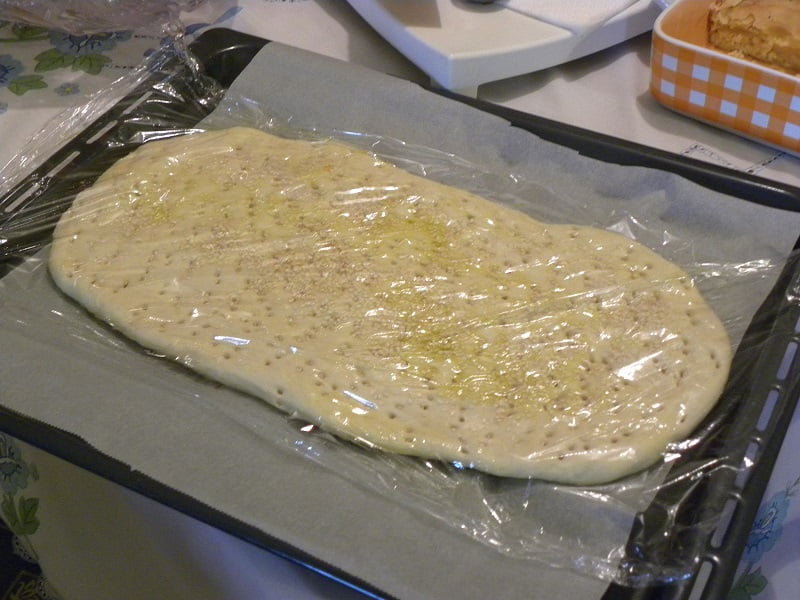
PROCEDURE TO MAKE LAGANA BREAD
TO MAKE THE DOUGH:
- In a bowl, combine the yeast, ¼ cup flour, sugar and lukewarm water. Mix it well and let the yeast proof for about 5 to 10 minutes. The yeast mixture would be very bubbly at the end of the 10 minutes. If not, the yeast might have become inactive. Discard this mixture and start with a fresh batch of yeast.
- I made the dough in my stand mixer but if you don't have one you can make it by hand. Add the flour, salt and olive oil to the bowl. Mix it a bit and then add the yeast mixture to the bowl as well as some lukewarm water.
- Knead the dough until it is very soft and not sticky. The dough will be on the softer side, but should not be sticky. Add more liquid or flour to get to the right consistency.
- Wet the dough with some olive oil, cover it with plastic wrap and then with a kitchen towel and place it in a warm place to rise. The time will depend on the room temperature.
TO SHAPE THE LAGANA AND BAKE
I made all the preparation from the previous day, so I left the dough in the fridge overnight and baked them in the morning.
If you want to prepare and bake them on the same day, you will need to bake them after the dough rises.
You can prepare the dough using a stand mixer or by hand.
I made the dough and after dividing it into two pieces, I made the classic lagana first.
- Punch the proofed dough gently and divide it into two pieces. Place half of it on a baking pan lined with parchment paper or you can grease your baking tin.
- Using your hand, stretch the dough and spread it all across the pan. Try to keep it evenly thick.
- Let the dough rest for about 30 to 40 minutes covered or until it rises again.
- Once the dough is ready, using your fingertips, poke some holes across the surface of the Lagana bread. (I usually use the stick of a wooden spoon as I have long nails and it's not convenient. I have also used a wooden souvlaki skewer to do smaller holes).
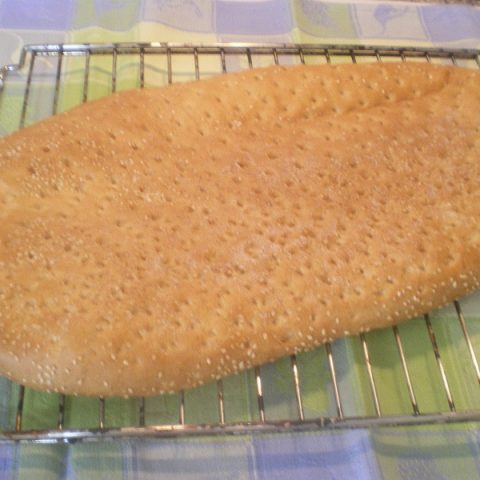
Traditional Lagana Flatbread
Lagana (in Greek λαγάνα, pronounced lah-GHAH-nah) is a traditional Greek flatbread, which is made with flour, yeast, salt and water.
Ingredients
- 500 grams bread flour
- 1 sachet (8 - 10 grams) dried yeast or 16 grams fresh yeast
- 1 teaspoon sugar
- ½ teaspoon salt
- 2 tablespoon olive oil
- About 1 cup lukewarm water
For sugar coating:
- 2 tablespoon water
- 1 teaspoon sugar
- 4 tablespoon sesame seeds
Instructions
- In a bowl, combine the yeast, ¼ cup flour, sugar and lukewarm water. Mix it well and let the yeast proof for about 5 to 10 minutes.
- Add the remaining flour, salt and olive oil to the mixer bowl and attach the hook. Mix it a bit and then add the yeast mixture.
- Knead the dough until it is very soft and not sticky.
- Add a tablespoon olive oil and grease the dough. Cover it with plastic wrap and then with a kitchen towel and place it in a warm place until it doubles in volume.
- Punch the proofed dough gently and divide it into two pieces Place half of it on a baking pan lined with parchment paper or you can grease your baking tin.
- Using your hand, stretch the dough and spread it all across the pan until it becomes 2 cm thick Try to keep it evenly thick.
- Let the dough rise again covered, until it rises again.
- Preheat the oven to 200o C / 400o F.
- Once the dough is ready, using your fingertips, poke some holes across the surface of the Lagana bread
- Brush the top with the sugar water and then sprinkle the sesame seeds.
- Bake in a preheated oven for about 25 to 30 minutes or
until the bread is golden brown. - Serve with your favourite Lenten food.
Nutrition Information
Yield 2 Serving Size 1Amount Per Serving Calories 1142Total Fat 26gSaturated Fat 4gTrans Fat 0gUnsaturated Fat 20gCholesterol 0mgSodium 1179mgCarbohydrates 191gFiber 9gSugar 5gProtein 34g
Kopiaste and Kali Orexi,

Oh my another keeper... this I must try to make 🙂 I can find the ingredients in my home. Recently I bought a bottle of kalamata olives but it's preserved in brine instead. Now, it's good excuse to use in this recipe. You think I can use machine to do the kneading? Will that change the taste and texture? I used to do pizza on my granite kitchen top but I can't nowadays with a 2 1/2 year old who wants attention and standing on his toes measuring himself against the height of my kitchen top...
As usual, wonderful history behind the food... Soon, I'm going to be very good in Greek History... xaxaxa... 😛
Hi Pixen. By all means you can do the kneading in your machine, just use the hook but believe me it's not necessary as no much kneading is involved.
wow! its looking so good!
Thanks Srilekha.
Another one of my favourites Ivy...I wish I could pop on over and indulge in that beautiful lagana! Love how used olives in the recipe too.
Thanks Peter. So many things you can make with Kalamata olives.
What a beautiful loaf sis..bread to me is beautiful and makes the whole house smell heavenly:D
This really looks SO good Ivy!!
Rosie x
I always love a bread that keeps well for several days. These look just beautiful!
Yum! Beautiful bread!